
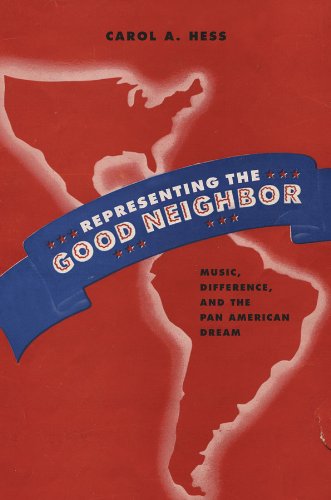
Representing the Good Neighbor: Music, Difference, and the Pan American Dream (Currents in Latin American and Iberian Music)
Product details
| Management number | 232007589 | Release Date | 2026/06/18 | List Price | US$16.83 | Model Number | 232007589 | ||
|---|---|---|---|---|---|---|---|---|---|
| Category | |||||||||
Winner of the 2015 Robert M. Stevenson Award from the American Musicological SocietyIn Representing the Good Neighbor: Music, Difference, and the Pan American Dream, Carol A. Hess investigates the reception of Latin American art music in the US during the twentieth century. Hers is the first study to probe Latin American art music in relation to Pan Americanism, or the idea that the American nations are bound by common aspirations. Under the Good Neighbor policy, crafted by the administration of President Franklin D. Roosevelt to cement hemispheric solidarity amid fears of European fascism, Latin American art music flourished and US critics applauded it as "universal." During the Cold War, however, this repertory assumed a very different status. While the United States supported Latin American military dictators to assuage fears that communism would overwhelm the hemisphere, musical works were increasingly objectified through essentializing adjectives such as "exotic," distinctive," or "national"--through the filter of difference. Hess explores this phenomenon by tracking the reception in the United States of the so-called Big Three: Carlos Chávez (Mexico), Heitor Villa-Lobos (Brazil), and Alberto Ginastera (Argentina). She also evaluates several important US composers and critics-Copland, Thomson, Rosenfeld, and others-in relation to Pan Americanism, and offers a new interpretation of a work about Latin America by US composer Fredric Rzewski, 36 Variations on "The People United Will Never Be Defeated!" Whether discussing works performed in modern music concerts of the 1920s, at the 1939 World's Fair, the inauguration of the New York State Theater in 1966, or for the US Bicentennial, Hess illuminates ways in which North-South relations continue to inform our understanding of Latin American art music today. As the first book to examine in detail the critical reception of Latin American music in the United States, Representing the Good Neighbor promises to be a landmark in the field of American music studies, and will be essential reading for students and scholars of music in the US and Latin America during the twentieth-century. It will also appeal to historians studying US-Latin America relations, as well as general readers interested in the history of American music. Read more
| ASIN | B00F1GAPJO |
|---|---|
| XRay | Not Enabled |
| ISBN13 | 978-0199339891 |
| Edition | 1st |
| Language | English |
| File size | 6.8 MB |
| Page Flip | Enabled |
| Publisher | Oxford University Press |
| Word Wise | Enabled |
| Print length | 336 pages |
| Accessibility | Learn more |
| Screen Reader | Supported |
| Part of series | Currents in Latin American and Iberian Music |
| Publication date | June 26, 2013 |
| Enhanced typesetting | Enabled |
Bestseller ranking
Ethnomusicology



Customers who viewed this product also viewed
Pharmacology





Correction of product information
If you notice any omissions or errors in the product information on this page, please use the correction request form below.
Correction Request Form